Luxembourg Art Week 2026: How a Small Country Became a Meeting Point for the International Art World
From a modest exhibition of around 20 galleries in 2015 to an international contemporary art fair featuring 78 exhibitors from 15 countries, Luxembourg Art Week returns to Glacis Square this November. Its 12th edition places photography in the spotlight while extending the experience into the streets, cultural institutions and exhibition spaces of the Grand Duchy.
Every autumn, Luxembourg becomes a meeting point for artists, gallery owners, collectors and people who simply enjoy discovering something new. For a few days, the international art world turns its attention towards the Grand Duchy, where established galleries and emerging creative voices come together to explore what contemporary art looks like today — and where it might go next.
Luxembourg Art Week has become one of the most visible events in the country’s cultural calendar. Yet its importance extends beyond the artworks displayed inside its temporary exhibition space. Through public installations, exhibitions, performances, discussions and partnerships with local institutions, the event invites people to encounter art in places they might not normally associate with galleries or museums.
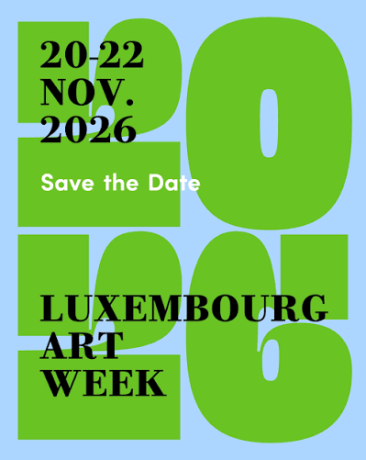
The 2026 edition takes place from 20 to 22 November at Glacis Square in Luxembourg City, bringing together 78 exhibitors from 15 countries. Photography will be a central theme, while the wider Art Week programme will encourage visitors to explore artistic projects across Luxembourg before, during and beyond the main fair.
For a country whose cultural identity has long been shaped by its position at the crossroads of Europe, the event offers a particularly fitting expression of Luxembourg’s international outlook.
From a small exhibition to an international art fair
The story of Luxembourg Art Week begins in 2015, when Luxembourg gallerist Alex Reding founded the event with the ambition of giving the contemporary art market a more prominent place in the country’s cultural life.
The first edition took place at Halle Victor Hugo in Limpertsberg. Around 20 galleries participated, attracting more than 7,000 visitors. For a first edition, this was a promising response and demonstrated that there was an audience for a dedicated art event capable of bringing galleries, collectors and curious members of the public together.
At the time, Luxembourg already possessed an established cultural infrastructure, including museums, galleries, exhibition venues and public collections. What the new fair sought to create was a meeting point between these different elements and the wider international art market.
The idea was not simply to organise an exhibition where artworks could be viewed or purchased. It was to create an occasion for encounters: between local and international galleries, experienced collectors and first-time buyers, established artists and emerging talent.
The second edition, in 2016, introduced Take Off, a section dedicated to emerging galleries and younger artists, with support from Luxembourg’s Ministry of Culture. The organisers also developed a VIP programme featuring collectors’ dinners, private lunches and guided visits to museums and corporate collections.
These additions helped establish two complementary ambitions that continue to define Luxembourg Art Week today: supporting the commercial side of contemporary art while encouraging a wider appreciation of artistic practice.
By 2017, the fair had grown to approximately 50 exhibitors and attracted more than 12,000 visitors over three and a half days. Art talks and lectures also became part of the programme, giving audiences opportunities to hear from artists, curators, critics, collectors and museum directors.
This was an important development. Contemporary art can sometimes appear difficult to approach, particularly for visitors unfamiliar with the language of galleries and the art market. Discussions and guided experiences help make the ideas behind the work more accessible, turning the fair into a place of learning as well as discovery.
Building connections across Luxembourg’s cultural landscape
In 2018, Luxembourg Art Week strengthened its relationships with regional cultural institutions and the press. Casino Luxembourg – Forum d’art contemporain was invited to develop a specially curated exhibition, while an opening party at the institution became part of the programme.
The following year marked the fair’s fifth anniversary and another significant step forward. Exhibition space expanded, the number of exhibitors rose to 65, and a new section called First Call was introduced to encourage international galleries to explore the Luxembourg market.
The programme also reached further into the city’s cultural life. Partnerships with Mudam Luxembourg and the University of Luxembourg brought conferences, performances, seminars and round-table discussions into the wider event. A sculpture was installed in public space for the first time, establishing a principle that would become increasingly important: art should not be confined to the walls of the fair.
Then came 2020, when the pandemic made a conventional exhibition impossible.
Rather than abandon its sixth edition, Luxembourg Art Week moved to a fully digital format. An online catalogue presented more than 1,500 works by 450 international artists, while virtual tours allowed visitors to explore the equivalent of 70 exhibitors’ stands.
The organisers reported reaching 30,000 visitors from 90 countries through the digital edition. The experience demonstrated that the fair could adapt to changing circumstances and maintain its international connections even when people could not gather in person.
It also reinforced the value of partnerships with Luxembourg’s cultural institutions, including Rotondes, the Centre national de l’audiovisuel and the Musée national d’histoire et d’art.
The subsequent editions continued the development of the fair as an international platform rooted in Luxembourg’s own cultural scene. In 2025, the 11th edition welcomed 77 exhibitors from 15 countries and placed Montréal in focus, highlighting the relationship between Luxembourg and another internationally connected cultural centre.
By 2026, the event had reached its 12th edition, with a programme that continues to combine galleries and art-market activity with public installations, institutional collaborations and opportunities for visitors to engage directly with contemporary art.
Luxembourg Art Week 2026: the key facts
The 2026 edition will be held at Glacis Square, also known as the Fouerplaatz, in Luxembourg City.
- Dates: 20–22 November 2026
- Location: Champs du Glacis, Allée Scheffer, Luxembourg City
- Edition: 12th
- Exhibitors: 78 from 15 countries
- International participation: 78% of exhibitors
- First-time participants: 22 exhibitors
- Main theme: Focus Photo, exploring photography across contemporary and historical artistic practices
The figures underline the event’s international reach. Nearly four in five exhibitors come from outside Luxembourg, while the 22 first-time participants offer opportunities to encounter galleries that have not previously taken part.
The fair’s scale is also significant in the context of Luxembourg’s size. It places galleries from the Grand Duchy alongside participants from a broad range of international art scenes, creating opportunities for conversations, commercial relationships and cultural exchange that might otherwise require visitors to travel to larger European art centres.
The full exhibitor list is available through the official Luxembourg Art Week website.
Focus Photo: photography takes centre stage
The defining theme of the 2026 edition is Focus Photo, a programme dedicated to the diversity of photography as an artistic medium.
The organisers have selected 26 international galleries for this focus. Some specialise in photography or place it at the heart of their artistic programmes. Others work across a broader range of contemporary art and will present photographers within dedicated sections of their stands.
This distinction reflects how photography has developed over the past two centuries. It can function as documentary evidence, a form of portraiture, an exploration of identity, a record of historical events or a carefully constructed artistic image. Contemporary artists also combine photography with installation, sculpture, performance, moving images and digital techniques.
As a result, photography is no longer easily defined by the idea of a single image hanging on a wall. Artists increasingly question how images are produced, manipulated, circulated and understood — and how the camera shapes our perception of the world.
The choice of theme also connects with the bicentenary of photography being marked in France during 2026–2027.
For Luxembourg, the subject has particular resonance because of its historical relationship with photography. The Grand Duchy is the birthplace of Edward Steichen, one of the most influential photographers and curators of the 20th century.
Born in Bivange in 1879, Steichen emigrated with his family to the United States as a child and went on to become a major figure in modern photography. His career encompassed artistic photography, fashion, portraiture and photojournalism, as well as his influential work as director of photography at New York’s Museum of Modern Art.
Steichen’s legacy remains visible in Luxembourg through the internationally renowned The Family of Man exhibition, housed at Clervaux Castle.
The Focus Photo programme therefore offers more than an opportunity to view photographic works. It places an international conversation about the medium in a country whose cultural history is closely connected to it.
Three sections, different ways to discover art
The fair’s structure is designed to accommodate different stages of artistic development and different approaches to presenting work.
The Main Section
The Main Section brings together established galleries from Luxembourg and abroad. Visitors can expect a broad panorama of modern and contemporary creation, spanning different generations of artists, artistic practices and geographical backgrounds.
This is where visitors can explore the work represented by established galleries, compare different artistic approaches and discover how individual galleries build their programmes around particular artists, movements or ideas.
For collectors, the section provides opportunities to encounter artists whose work may already have an established market. For other visitors, it offers an introduction to the range of work currently represented by galleries operating in the international art world.
Take Off
Take Off focuses on younger galleries, defined by the organisers as galleries less than five years old, alongside emerging talent.
The section gives newer galleries a platform from which to introduce their artists and curatorial approaches to a wider audience. It also offers visitors a chance to encounter practices that may not yet be widely represented in established collections.
Emerging galleries play an important role in the art ecosystem. They often take risks on artists at earlier stages of their careers, introduce unfamiliar ideas and help create the conditions for new artistic movements to develop.
For visitors, Take Off can be one of the most rewarding places to explore precisely because the names on display may be less familiar.
Projects & Institutions
The Projects & Institutions section brings cultural organisations and institutional participants into dialogue with the galleries.
Its purpose is to broaden the experience beyond conventional commercial presentations, creating space for different forms of display, knowledge-sharing and cultural engagement.
Together, the three sections demonstrate that Luxembourg Art Week is not simply a collection of sales stands. It is an attempt to bring different parts of the art world into the same conversation, from commercial galleries and emerging artists to cultural institutions and the wider public.
Art Walk: taking contemporary art into the city
One of the most distinctive features of Luxembourg Art Week is that the experience extends beyond Glacis Square.
Beginning in October, the Art Walk programme brings contemporary art into public spaces through two complementary projects: the sculpture trail and (capsules).
The sculpture trail introduces large-scale artworks into the urban environment, encouraging people to encounter art while moving through the city. Rather than requiring a visit to a museum or gallery, these works become part of the everyday landscape.
For passers-by, the experience may be unexpected. A sculpture can interrupt a familiar view, change the way a public space is perceived or encourage a closer look at a place normally crossed without much thought.
The 2026 programme includes Tony Cragg’s Mean Average, from 2018, presented as part of the sculpture trail from 3 to 22 November.
Cragg is internationally recognised for his sculptural practice, which explores form, material and the relationship between objects and the natural world. The presentation provides an opportunity to encounter his work within Luxembourg City’s public environment.
The second project, known as (capsules), brings artistic interventions into vacant shop windows. These installations can be viewed around the clock, allowing people to discover contemporary art outside normal gallery opening hours.
The 2026 programme includes work by Marta Djourina and Andréa Vamos, as well as Lucas Castel. The organisers are also publishing interviews with participating artists, offering further insight into the creative thinking behind the installations.
This approach has a wider significance. Empty commercial spaces are often regarded as signs of economic inactivity, but they can also become temporary sites for creativity. By transforming shop windows into exhibition spaces, (capsules) creates an encounter between contemporary art and the rhythms of everyday urban life.
The Art Walk therefore expands the fair’s reach in a practical way: people who might never buy a ticket to an art fair can still experience some of its artistic programme simply by walking through Luxembourg City.
Talks, tours and cultural partnerships
The wider programme for 2026 includes discussions, guided tours, performances, workshops and events developed in collaboration with Luxembourg’s cultural institutions.
These activities provide opportunities to explore questions that extend beyond individual artworks. How does photography influence the way history is recorded? What responsibilities do collectors have towards the artists whose work they acquire? How can cultural organisations support emerging talent? And what happens when art meets architecture, music, business or academic research?
Among the scheduled discussions are:
- Women Photographers Today: How Can They Create, Be Represented and Be Recognised? — a discussion on 19 November examining representation and recognition within photography.
- Private Photography Collections: The Challenges of Curation, Conservation, Public Engagement and Support to the Artists — scheduled for 20 November.
- Issues and Perspectives on Research on Women Artists — taking place on 21 November.
- Beyond Sponsorship: Where Art & Enterprise Co-Create — a discussion scheduled for 22 November.
- Art and Academia: Fostering Reflection and Experimentation — bringing artistic and academic perspectives together on 21 November.
The programme also includes Step Across the Border: An Art Scene Spanning the Grande Région, a round-table discussion scheduled for 18 November in collaboration with Casino Luxembourg and Mudam Luxembourg. It explores the idea of an art scene that extends beyond national boundaries, reflecting the close cultural connections between Luxembourg and its neighbouring regions.
Performances and workshops are also part of the programme. A workshop with the Némo Flouret dance company is scheduled for 21 November in collaboration with Mudam Luxembourg, while Guilherme Vaz’s Sinfonia do Fogo is listed for the same day as a co-production between Mudam and the Philharmonie’s 2026 rainy days festival.
The fair also offers free guided tours on Saturday 21 November and Sunday 22 November, from 15:00 to 17:00. These tours are designed to provide visitors with more context about the artworks, artists and curatorial choices.
Visitors who would prefer a more personalised experience can also enquire about private guided tours through the organisers.
The full programme, including locations and any booking requirements, is available at luxembourgartweek.lu.
Can you buy art at Luxembourg Art Week?
Although visitors can attend simply to look, learn and discover, the fair also provides a direct opportunity to purchase artworks.
Buying art can seem intimidating, particularly for people who have never visited a gallery or spoken to an art dealer. Prices may be unfamiliar, artists’ careers can be difficult to assess, and visitors may be uncertain about how to begin.
Luxembourg Art Week addresses this through its Collecting 101 initiative, which identifies works priced below €4,000.
The idea is to make the process of acquiring art more approachable and encourage visitors to begin conversations with galleries, artists and exhibitors.
Buying an artwork need not begin with an investment strategy or a detailed knowledge of art history. For many people, it begins with an image, an object or an idea that holds personal meaning.
The opportunity to ask questions directly — about the artist, the materials, the work’s background or its availability — is one of the advantages of visiting a fair in person.
For emerging artists and galleries, these encounters can also be valuable. They create opportunities to explain the work, establish relationships with new audiences and connect with potential collectors.
Why Luxembourg Art Week matters to the Grand Duchy
Luxembourg Art Week occupies an interesting position within the country’s cultural landscape.
Luxembourg is a small country with an unusually international population and a cultural life shaped by several languages, neighbouring countries and cross-border movement. Its location makes it a natural meeting point for artists, galleries and audiences from Luxembourg, France, Belgium, Germany and further afield.
An event bringing 78 exhibitors from 15 countries into the capital reflects that international character.
At the same time, the fair’s relationship with local museums, galleries, cultural associations and public spaces helps ensure that it is not disconnected from the country hosting it.
The sculpture trail, temporary shop-window installations, talks and institutional collaborations all contribute to a broader cultural programme. They allow the event to reach people who may not consider themselves art collectors or regular gallery visitors.
There is also an economic dimension. Art fairs create opportunities for galleries to meet buyers, establish contacts and develop relationships with new markets. For a country seeking to strengthen its international cultural profile, such events can help demonstrate that Luxembourg is not merely a financial centre or a convenient base for international business, but also a place where artistic ideas are produced, exhibited and exchanged.
The presence of emerging galleries is particularly important in this respect. International cultural reputation is not built solely by attracting established names. It also depends on providing opportunities for new talent and supporting the organisations willing to take risks on unfamiliar work.
Luxembourg Art Week’s development since 2015 suggests that the fair has increasingly sought to balance these ambitions.
Planning your visit to Luxembourg Art Week 2026
The main fair takes place at Glacis Square, also known as Fouerplaatz, in Luxembourg City, from Friday 20 November to Sunday 22 November.
The venue is located on Allée Scheffer. The organisers advise visitors to check the official website for the latest opening hours, ticket prices, accessibility information and any changes to the programme.
A useful starting point is to decide whether you want to focus on the fair itself or explore the wider Art Week programme.
Visitors primarily interested in buying or discovering artworks may wish to spend several hours exploring the gallery sections. Those more interested in photography can use Focus Photo as a guide, while visitors who prefer a broader cultural experience can combine the fair with the sculpture trail, (capsules), exhibitions and public talks.
The Art Walk installations are particularly useful for people who want to experience the event at their own pace, while guided tours provide an introduction for visitors who would appreciate additional context.
Because events take place across multiple venues, it is worth checking locations and booking requirements in advance, particularly for workshops, performances and scheduled discussions.
For the latest information, visit the official Luxembourg Art Week website.
A growing cultural tradition
When Luxembourg Art Week opened its doors for the first time in 2015, around 20 galleries and more than 7,000 visitors established the foundations for a new cultural event.
Eleven years later, its 12th edition brings together 78 exhibitors from 15 countries, alongside an extensive programme of exhibitions, installations, talks, tours and performances.
The numbers illustrate the fair’s growth, but its development can also be measured by the way it has expanded beyond the original exhibition format. Contemporary art now appears not only inside the fair but also in public spaces, shop windows, cultural institutions and discussions that invite people to consider the role of art in everyday life.
In 2026, photography provides a compelling thread through this programme, connecting the work of international galleries with Luxembourg’s own artistic heritage and the legacy of Edward Steichen.
For experienced collectors, the event offers a chance to discover artists and galleries. For emerging creatives, it creates opportunities for exposure and exchange. For the general public, it provides an accessible way to encounter contemporary art and explore the ideas shaping it.
And for Luxembourg itself, it is another opportunity to demonstrate how a small country can play an active role in a much larger cultural conversation.
Luxembourg Art Week 2026 takes place from 20 to 22 November at Glacis Square in Luxembourg City. Whether visitors arrive looking for a particular artist, an artwork to take home or simply a new cultural experience, the invitation is the same: take a closer look at the art being made today, and discover the people and ideas behind it.
For further information, the full exhibitor list and the programme of events, visit www.luxembourgartweek.lu.