
BENEATH LUXEMBOURG
The extraordinary story of the Casemates
Beneath the streets, squares and elegant buildings of Luxembourg City lies another Luxembourg. A world of tunnels, gun positions, barracks, wells and secret passages carved into the rock. Built to defend a fortress that European powers fought to control, the Casemates have since sheltered soldiers, civilians, champagne, mushrooms, theatre and tourists. Their story is, in many ways, the story of Luxembourg itself.
There is something slightly magical about standing in Luxembourg City and knowing that, just a few metres beneath your feet, another city once existed.
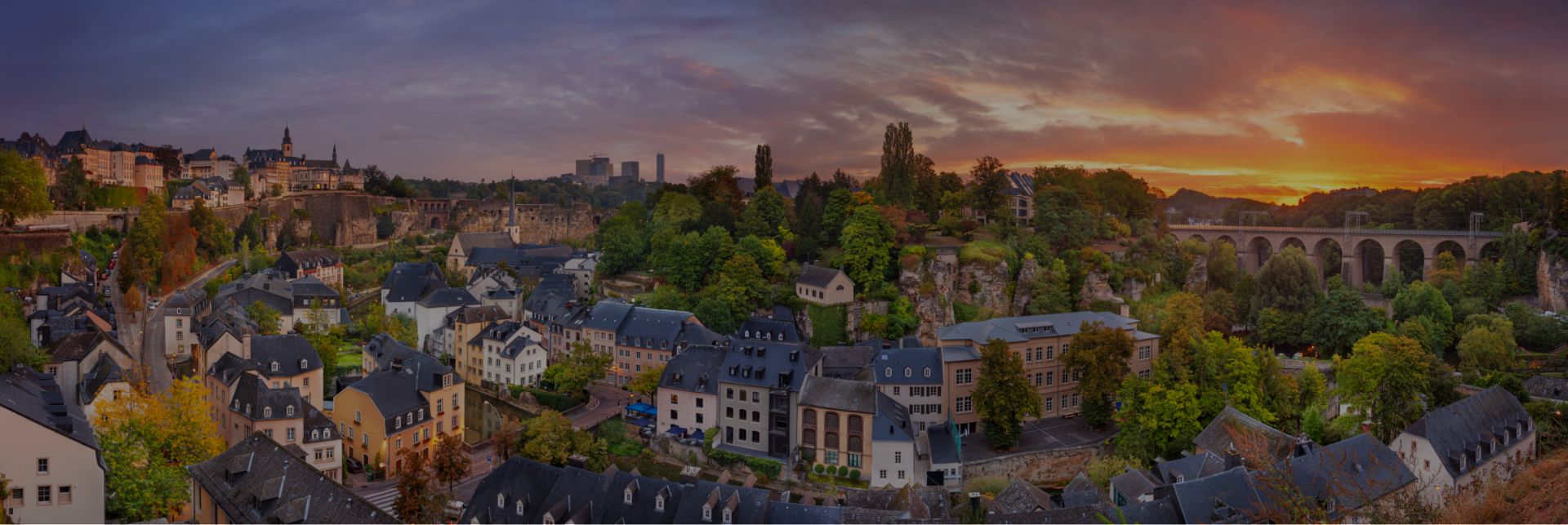
You can walk across Place de la Constitution, admire the Gëlle Fra, look down towards the Pétrusse valley and see a modern European capital. But underneath that landscape are galleries cut deep into the rock, chambers where soldiers slept, guns were positioned, supplies were stored and, centuries later, ordinary people sought protection from bombs.
These are the Casemates of Luxembourg.
They are among the most remarkable surviving traces of the city’s extraordinary military past—and they help explain why Luxembourg was once regarded as one of the most important fortresses in Europe.
It all began on the rock
The story goes back much further than the tunnels themselves.
In 963, Count Siegfried established a fortress on the rocky Bock promontory overlooking the Alzette. The location was almost absurdly well suited to defence: steep cliffs dropped towards the valleys on three sides, while the elevated rock provided a commanding position over the surrounding countryside.
That small fortress eventually gave its name to the city and, ultimately, to the country.
Over the centuries Luxembourg passed through the hands of some of Europe’s greatest powers. Burgundians, Habsburgs, Spanish rulers, French armies, Austrians and later Prussians all recognised the extraordinary strategic value of the location.
The medieval castle itself eventually became obsolete as artillery transformed warfare. A castle designed to withstand swords and siege ladders was not enough against increasingly powerful cannon.
So Luxembourg began to disappear into the rock.
The Spanish start digging
The Casemates we recognise today are principally the product of the great transformation of Luxembourg into a modern artillery fortress.
Under Spanish rule, the first major underground galleries were constructed in the 17th century. Sources from Luxembourg City date the beginning of the Casemates to 1644, when the Spanish began extending underground spaces around the old Bock fortress.
But this was only the beginning.
When Louis XIV’s France captured Luxembourg in 1684, the famous French military engineer Sébastien Le Prestre de Vauban was brought in to redesign and strengthen the fortress.
Vauban was arguably the greatest military engineer of his age. His approach was brutally practical: if an enemy could attack it, strengthen it; if soldiers needed to move through it, build a protected route; if artillery could reach it, put another layer of defence in front of it.
Between 1685 and 1688, thousands of workers transformed Luxembourg’s fortifications. Vauban’s work gave the city the character that would eventually earn it the extraordinary nickname “Gibraltar of the North.”
The Austrians subsequently continued the work.
And they went underground in a big way.
A city beneath the city
By the 18th century, the fortress contained an enormous network of underground galleries.
At the Bock, the Austrians substantially expanded the casemates from 1744 onwards. The principal Bock casemate was approximately 110 metres long and up to seven metres wide, with numerous gun positions designed to produce devastating crossfire.
The underground fortress was not simply a collection of tunnels.
It was infrastructure.
There were barracks, workshops, kitchens, bakeries, storage areas and even slaughtering facilities. At its height, the Bock complex could accommodate around 1,200 soldiers and their horses, together with dozens of cannon.
And then there was water.
Deep inside the Bock was an old well reaching approximately 47 metres into the rock. During a siege, access to a reliable water supply could mean the difference between holding a fortress and surrendering it.
This is what makes the Casemates so fascinating. They weren’t merely hiding places. They were effectively a military city built inside the mountain.
The Pétrusse has its own story
The Casemates beneath the Pétrusse valley developed as part of another major section of the fortress.
The Spanish built the Ravelin du Pâté in 1673 to strengthen the Beck Bastion. Vauban later reshaped the Pétrusse defences, while the Austrians added the Bourbon Lock and Grand Staircase in the 1720s. In 1746, the Casemates known as the Batterie de la Pétrusse were constructed, containing numerous gun positions.
Unlike the Bock, the Pétrusse position was particularly important for controlling the valley.
Today, however, it is difficult to look at the peaceful green Pétrusse valley and imagine it as a battlefield.
The landscape hides its past remarkably well.
When Luxembourg finally faced invasion
The fortress wasn’t simply built for decoration.
In 1794, Revolutionary France surrounded Luxembourg.
The siege and blockade lasted from November 1794 until June 1795. The fortress eventually surrendered to French Republican forces, after which Luxembourg became part of the French Republic as the Département des Forêts.
The irony is striking.
A fortress that had become one of the most heavily defended places in Europe eventually surrendered not because its walls were necessarily incapable of resisting, but because prolonged blockade made continued resistance impossible.
The Casemates had helped make Luxembourg enormously difficult to conquer.
But no fortress could escape the changing nature of warfare.
The end of the fortress
After Napoleon’s defeat and the Congress of Vienna, Luxembourg became a Grand Duchy and was incorporated into the German Confederation. Prussian forces occupied the fortress and continued strengthening it.
By the 19th century, however, the strategic world was changing again.
Artillery was becoming more powerful. New weapons could reach farther. European politics was shifting.
Following the Austro-Prussian War and rising tensions between France and Prussia, Luxembourg’s position became particularly sensitive.
The answer came with the Treaty of London in 1867.
The great fortress was to be dismantled.
Luxembourg’s centuries as a fortified military stronghold were coming to an end.
Above ground, huge sections of the fortress were demolished. But destroying everything underground was another matter.
The Casemates were simply too deeply embedded in the rock.
Instead of disappearing completely, much of this extraordinary subterranean world survived.
UNESCO describes the former fortress as one of Europe’s great fortified sites and notes that, despite the dismantling after 1867, numerous bastions, forts, redoubts and casemates survived.
And then something rather unexpected happened…
You might imagine that once the fortress had lost its military purpose, the Casemates simply became abandoned tunnels.
They didn’t.
Their second life was remarkably colourful.
From 1871, the Pétrusse Casemates were used by the shooting society d’Schéiss.
In the 1890s, gardeners Backes and Schneider discovered another use for the underground environment: they grew mushrooms in the Ravelin du Pâté, known locally as the “Pastetchen”.
And then came champagne.
The E. Mercier champagne company used parts of the Casemates to store bottles. The cool, dark underground environment was naturally suited to storage.
So, after centuries of being designed to survive war, Luxembourg’s underground fortress found itself helping to store one of the world’s favourite symbols of celebration.
There were also concerts, beer festivals and charity bazaars.
The Casemates had gone from military stronghold to something approaching an underground community space.
The Casemates became a refuge once again
Their defensive purpose returned in the 20th century—but this time the enemy came from above.
During both World Wars, the Bock and Pétrusse Casemates were used as shelters for civilians.
In the event of an air raid or bombardment, the underground galleries could reportedly provide protection for as many as 35,000 people.
This is perhaps one of the most poignant aspects of their history.
The same rock that had once sheltered soldiers from cannon fire now sheltered Luxembourg’s population from bombs.
The purpose had changed.
The need for protection had not.
From shelter to tourist attraction
Eventually, the Casemates began another transformation.
On 22 July 1933, the Pétrusse Casemates opened to visitors.
There was no sophisticated lighting system and no polished tourist experience. The first visitors descended into the darkness carrying torches.
And they came in surprisingly large numbers.
Around 5,000 people visited during the first season.
Almost a century later, it is easy to forget how unusual this must have seemed.
People weren’t merely visiting a monument.
They were walking through a place that had been designed for war, then abandoned, reused and eventually transformed into an attraction.
The theatre beneath the Bock
Perhaps one of the most unusual chapters in the story came in 1964.
The Casemates became home to a theatre company founded by Luxembourgish actor Tun Deutsch.
The subterranean setting was perfect for experimental theatre, and performances included works associated with the avant-garde, including Samuel Beckett.
Think about that for a moment.
A place originally engineered for cannon fire became a theatre.
The rock walls that once echoed with military orders instead carried actors’ voices.
It is difficult to imagine a better example of Luxembourg repeatedly reinventing its own past.
The tunnels that almost vanished
There is another fascinating detail about the Casemates.
At one point, the network was considerably larger than what visitors can see today.
Historical sources describe a network extending for roughly 23 kilometres through several levels and, in places, reaching around 40 metres below ground. Following the dismantling of the fortress in 1867, the remaining accessible network was reduced to around 17 kilometres.
This is why the frequently repeated claim that Luxembourg has “17 kilometres of Casemates” needs a little context.
The figure generally refers to what remained after the fortress was dismantled—not necessarily the total extent of the historical underground defensive system.
Much of the original fortress is gone.
Much remains inaccessible.
And some of it is simply part of the rock beneath the modern city.
The UNESCO connection
In 1994, Luxembourg’s Old Quarters and Fortifications were inscribed on the UNESCO World Heritage List.
UNESCO considers the site significant because Luxembourg represents an exceptional example of a fortified European city whose military architecture developed over several centuries and under successive European powers.
That is important because the Casemates are not an isolated attraction.
They are part of a much larger historical landscape.
The Bock, Pétrusse valley, surviving bastions, old streets, bridges and defensive structures all tell the same story.
Luxembourg was shaped by its fortress.
The streets developed around it. Houses had to coexist with military structures. Entire neighbourhoods lived in the shadow of the walls.
The city wasn’t simply a city with a fortress.
For centuries, the fortress was the reason the city existed in the form it did.
And today?
Today, you can descend into the Bock Casemates and stand where soldiers once stood.
You can look through openings in the rock towards the Grund, Clausen and Pfaffenthal and realise that those spectacular views were once military advantages.
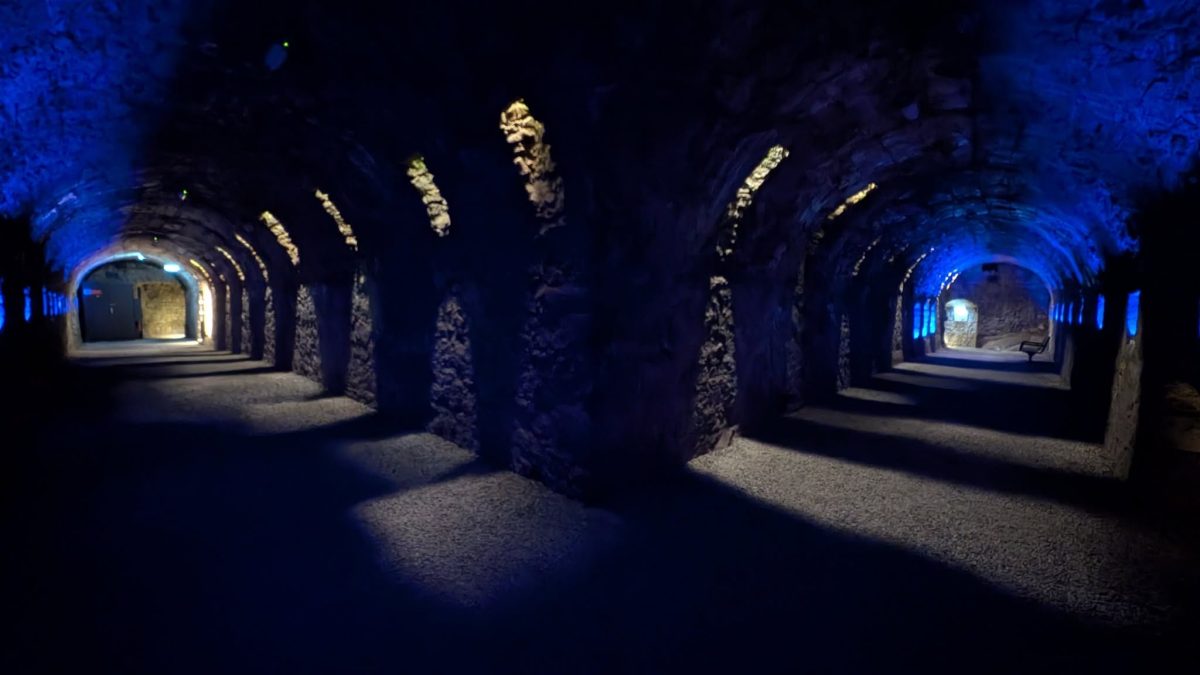
You can explore the Pétrusse Casemates and walk through passages that have witnessed several completely different chapters of Luxembourg’s history.
The Pétrusse Casemates have also recently been given a new visitor experience, using lighting and scenography to bring the underground environment and its history to life.
But perhaps the most interesting way to experience the Casemates is to stop thinking of them simply as tunnels.
They are layers.
The medieval castle is there.
The Spanish fortress is there.
Vauban’s engineering is there.
The Austrian military machine is there.
The Prussian fortress is there.
The soldiers are there.
The siege is there.
The champagne bottles are there.
The mushroom growers are there.
The theatre performers are there.
And, in a very real sense, the people who sheltered from two world wars are there too.
Every generation found a different reason to enter the darkness.
A fortress that refused to disappear
The great irony of Luxembourg’s Casemates is that they were built to help preserve a fortress that no longer exists.
The walls came down.
The military importance disappeared.
The armies left.
The political map of Europe changed again and again.
But the rock remained.
And so did the tunnels.
Today, Luxembourg is no longer the “Gibraltar of the North” in any military sense. It is a European capital, a financial centre, a home to international institutions and one of the world’s smallest sovereign states.
Yet underneath that modern city lies the physical memory of a very different Luxembourg.
A Luxembourg that was fought over.
A Luxembourg that was besieged.
A Luxembourg that belonged, at different times, to powerful European dynasties and empires.
A Luxembourg whose inhabitants once depended upon these dark galleries for their survival.
And perhaps that is why the Casemates remain so compelling.
You don’t simply walk through Luxembourg’s history when you enter them.
You walk underneath it.
You can book tickets to visit the casemates by clicking here.