The Story of Luxembourg’s Red Lions
If you have ever watched Luxembourg play football, seen the country’s national teams competing abroad, or simply looked at Luxembourg’s coat of arms, you will almost certainly have encountered the Red Lion.
Known in Luxembourgish as the Roude Léiw, it is one of the country’s most recognisable symbols. It appears on coats of arms, sporting shirts, official imagery and countless representations of Luxembourg.
But why a lion? Why is it red? And perhaps most intriguingly, why does the lion appear to have one tail in some historical images and two in others?
The story takes us back almost 800 years, to medieval Europe, noble dynasties and territorial claims.
A symbol dating back to the Middle Ages
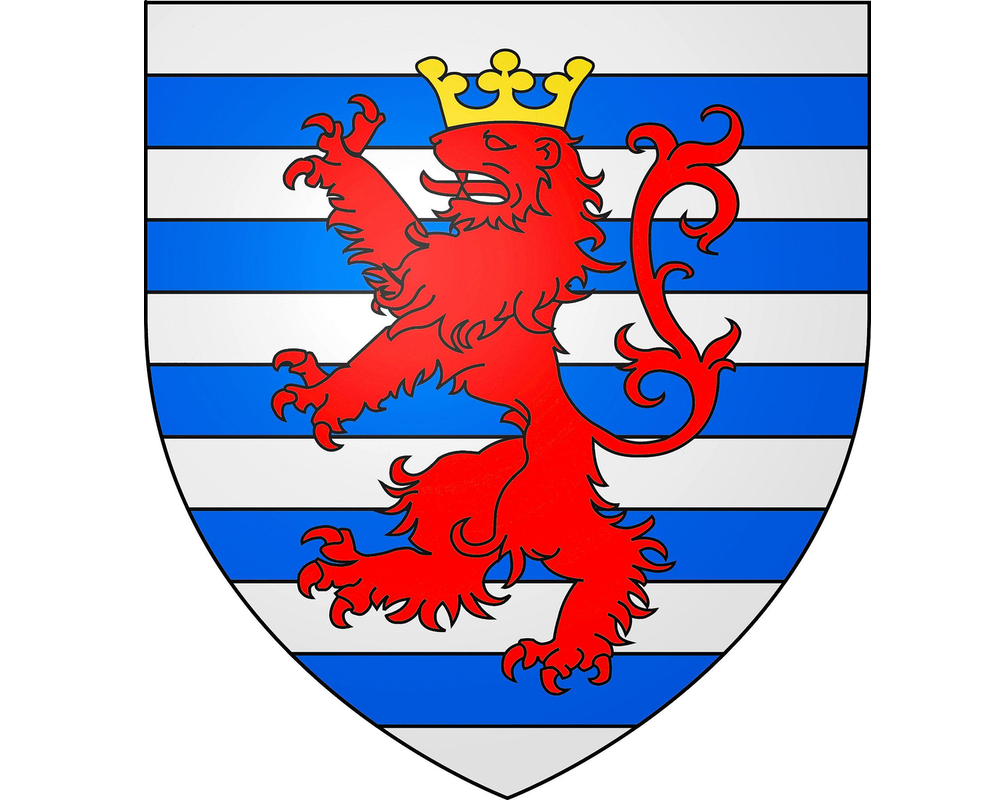
The Luxembourg coat of arms was established in its basic form between 1235 and 1239 under Henry V, Count of Luxembourg. The design consisted of a red lion on a field of alternating silver and blue horizontal stripes.
This was a very different world from the Luxembourg we know today.
There was no modern nation state, no Luxembourgish passport and no European Union. Territories were controlled by counts, dukes and other noble families, and coats of arms were an important way of identifying rulers and their possessions.
The lion was therefore originally a heraldic symbol of a ruling dynasty and territory, rather than a national emblem in the modern sense.
Over the centuries, however, the symbol became increasingly associated with Luxembourg itself.
Why a lion?
The lion was one of the most popular animals in medieval European heraldry.
It represented qualities such as strength, courage, authority and nobility — characteristics that rulers were keen to associate with themselves.
Luxembourg’s lion was not unique in this respect. Lions appear on the coats of arms of numerous European royal families, cities and territories.
What makes the Luxembourg lion distinctive is the particular combination of a red lion, gold crown and claws, and a blue-and-silver striped background.
The modern Luxembourg coat of arms retains these elements today. The official version depicts a crowned red lion with golden claws and tongue on ten alternating silver and blue bands.
But there is another feature that makes the Luxembourg lion particularly interesting.
Its tail.
One tail or two?
Look at different pictures of Luxembourg’s Red Lion and you may notice something strange.
Some lions appear to have one tail.
Others clearly appear to have two tails crossing each other.
So which one is correct?
The answer is: both versions existed at different points in history.
The earliest Luxembourg lion associated with Henry V had a single tail. This helped distinguish his arms from those of his father, Waleran III, Duke of Limburg, whose lion was already shown with a forked or double tail.
Then, in 1282, Henry VI of Luxembourg made an important change.
He doubled the lion’s tail and crossed the two parts of it in the heraldic pattern known as sautoir. This was connected with Henry VI’s claim to the Duchy of Limburg, whose heraldic lion also featured a forked tail.
The change did not last permanently.
After Henry VI’s death at the Battle of Worringen in 1288, his successor Henry VII reverted to the earlier Luxembourg arms associated with Henry V.
This helps explain why historical representations of the Luxembourg lion can look surprisingly different.
So does today’s Red Lion have two tails?
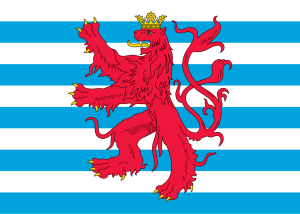
Technically, no — it has one forked tail.
This is an important distinction.
The modern official coat of arms describes the lion as having a “forked tail crossed in saltire”. In other words, it is one tail which divides into two parts, with those two parts crossing each other.
It is therefore perfectly understandable to look at the modern emblem and say, “That lion has two tails.”
But in heraldic terms, it is a single forked tail.
The design is now one of the defining characteristics of Luxembourg’s official lion.
From medieval dynasty to national identity
For centuries, Luxembourg’s political status changed repeatedly.
The territory passed through the hands of powerful European dynasties and became connected to much larger political entities. The House of Luxembourg itself became one of medieval Europe’s most influential ruling families.
Members of the dynasty would eventually become kings of Bohemia and Holy Roman Emperors.
Yet through all these changes, the Luxembourg lion continued to appear in heraldry.
That is what makes the symbol so fascinating.
It began as the emblem of a medieval count and his territory. Over time, it survived changes of rulers, political alliances and borders and gradually became associated with the identity of Luxembourg itself.
When Luxembourg eventually became a Grand Duchy in 1815, the lion was already centuries old.
The Red Lion becomes a symbol of Luxembourg
Modern national symbols often have medieval origins.
A coat of arms that once represented a noble family can eventually come to represent an entire country.
That is exactly what happened with Luxembourg’s lion.
Today, the coat of arms is one of Luxembourg’s legally protected national symbols, alongside the national flag and anthem.
The Grand Duchy’s coat of arms exists in three forms — small, medium and large, with the more elaborate versions incorporating additional historical and dynastic elements.
But at the heart of all of them is the familiar Red Lion.
From heraldry to the football pitch
Perhaps the place where the Red Lion is most visible to modern audiences is sport.
Luxembourg’s national football team is known as D’Léiwen — the Lions.
The nickname provides a direct connection between the country’s medieval heraldic tradition and modern sporting identity.
When the Luxembourg national team walks onto the pitch, the Red Lion is displayed on the players’ shirts and associated with the team’s identity.
And while Luxembourg has historically been one of Europe’s smaller football nations, the symbolism is anything but small.
The lion represents the country itself: proud, determined and willing to compete against much larger neighbours.
The lion beyond football
Football may have made the Red Lion particularly familiar to younger generations, but its presence extends far beyond sport.
It appears in Luxembourg’s heraldry, historic buildings, official representations, cultural material and national celebrations.
The Grand Ducal coat of arms itself features Luxembourg’s lion prominently. The Grand Ducal Court explains that the modern arms retain the Luxembourg lion with its characteristic forked tail crossed in saltire, while other elements reflect Luxembourg’s dynastic connections with the House of Nassau and the House of Bourbon-Parma.
This is another reminder that Luxembourg’s symbols are really a visual history book.
The lion tells one story.
The stripes tell another.
The other lions, crowns and heraldic elements tell yet more stories about the families and territories that shaped the country.
A lion shared with a complicated European past
One of the fascinating things about heraldry is that national symbols did not develop in isolation.
Medieval Europe was a web of marriages, inheritance, alliances and territorial claims.
The Luxembourg and Limburg lions were closely connected through the dynastic history of the region, which helps explain why the design of the tail became an important heraldic detail.
The fact that Henry VI altered the tail in 1282 was not simply an artistic decision. Heraldry could be used to communicate political claims.
A change to a coat of arms could effectively say:
“This territory belongs to my family, and I have a right to it.”
That makes the Red Lion much more than a decorative animal.
It was medieval political communication.
A symbol that survived 800 years
Perhaps the most remarkable thing about Luxembourg’s Red Lion is its longevity.
The Luxembourg coat of arms has been modified many times, but its basic origins can be traced back to the 13th century.
Think about everything that has happened since then.
Kings and emperors have risen and fallen.
Borders have moved.
Wars have transformed Europe.
The fortress of Luxembourg has changed from a military stronghold into a historic landmark.
The country has gone from an agricultural society to a major industrial power and then to one of the world’s most international financial centres.
And through all of that, the Red Lion has remained.
From medieval shield to modern symbol
Today, most people don’t see the Red Lion and immediately think about medieval territorial claims.
They might think of Luxembourg football.
They might think of the Grand Ducal Family.
They might think of Luxembourg itself.
And that is perhaps the ultimate success of a national symbol.
The Red Lion has travelled from a medieval count’s coat of arms to the modern Grand Duchy, surviving centuries of political and social change along the way.
Even its unusual tail tells part of that story.
The single-tailed lion of the early Luxembourg arms, the double-tailed version associated with Henry VI’s claim to Limburg, and the modern forked tail crossed in saltire are all chapters in the evolution of the same remarkable symbol.
So the next time you see the Roude Léiw, whether it is flying above a sporting event, appearing on a Luxembourg coat of arms or printed on the shirt of the national football team, remember that you are looking at something much older than modern Luxembourg.
You are looking at a symbol whose story began almost 800 years ago — and which is still very much alive today.